By Owen Neaman
This article was originally written for a December 2025 assignment. The figures of Jim E. Brown’s followers on Instagram has grown from 150,000 to over 240,000 at the time of this upload, and this piece centers around a show that occurred in October 2025. All other details about the subject remain the same.
I’m standing in line outside Le Poisson Rouge in Manhattan’s Greenwich Village. It’s my first time attending the multi-stage 750-capacity venue, which is quietly tucked under what looks like a beige-bricked residential building. The venue’s doorway is almost invisible tonight, buried deep in the constant downtown honk of tourists and NYU students, but the line of people clad in black wraps around the block, eventually leading the eye to a doorway. The crowd’s here to see Lebanon Hanover, the sensual, vampiric, ever-so-serious goth duo from England. A legion of fans have come to get a dose of traditional gothic dance music, not too far off from 1980s groups like Sisters of Mercy or The Cure. I might as well be one of them, dressed in black and dolled up with eyeliner, but I’m really here to see the opening act: Jim E. Brown, the self-proclaimed “19-year old obese alcoholic with degenerative conditions, born one day before ‘the 911.’” This is who Lebanon Hanover handpicked to open for them on an entire leg of their tour?
To understand just how out of place Brown seemed in the opening slot for Lebanon Hanover, one doesn’t have to look further than his Instagram page. My friend and bandmate Isen Ritchie, who accompanied me to this concert, showed me one of Brown’s many restaurant reviews, which have amassed hundreds of thousands of views and over 150,000 followers on Instagram. Each video begins the same, and follows the exact same format:
“Right, my name is Jim E. Brown. I’m here in the American city of New York.”
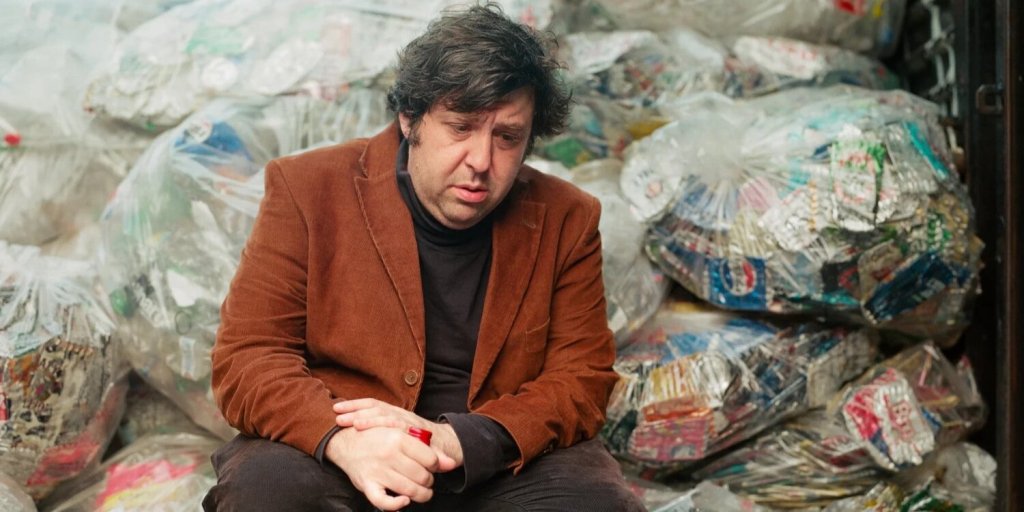
A handheld iPhone camera pans up to a paunchy man, appearing to be in his mid-50s, sitting at a table in a restaurant. His wardrobe consists solely of cheap-looking polos and t-shirts, sometimes topped by a trademark tweed jacket. His cheeks are saggy and his mouth is perpetually fixed in a moping frown. Beneath a disheveled mop of greying hair is a pair of eyes that only squint with apathetic cynicism or droop with misery.
“I’m just enjoying a pint before me gig. I’ve ordered this French Onion Soup.”
Brown’s thick Manchester accent is agonizingly whiny—a droning, hilarious caricature of Manchester legends like Morrisey and the Gallagher Brothers. A whininess soaked in a state of perpetual hangover. In whatever restaurant he patronizes, he looks like he’s just woken up after an ugly bender and is reminding himself where he is and what his name is.
“It looks more like a pizza though really, it’s just like a pizza.”
Brown’s analysis of delicacies all over the world parodies the Anthony Bourdains of the world. He messily scoops up a bite of the cheesy soup, strings of loose cheese dangling from his mouth as he chews introspectively.
“It’s lovely…it’s just like a pizza, really. But instead of being atop bread it’s just in a pool of, like, brown hot water.”
His frown doesn’t break, he critiques the food matter-of-factly and devoid of emotion. But for regular viewers, this is an above-average review: Brown’s vocabulary when describing the food he eats rarely extends beyond “rather shit” or “quite nice” in terms of adjectives. Quite lovely? The viewer has to wonder what’s put him in such a good mood today. He seems to have an Addams Family-esque taste: fruits, vegetables, and water repulse him, and his main salve is sausage rolls (and other things he describes as “fat fuck foods”) and alcohol. At the end of every video, he signs off with “right, my name is Jim E. Brown.”
When Isen sent me Brown’s video, I initially shrugged it off. We’re in a noise rock band together, and often send dozens of videos of strange media we find every day as a means of inspiration and entertainment. Brown just happened to be an online presence we found funny, and we found him funny enough to buy tickets to his show. The more I heard about him online, though, the more concerning his act seemed to be. Nobody in the comments section truly believed that Brown is 19 years old—did they? If anything, it’s undeniable that he’s an alcoholic, with videos upon videos of him drinking heavily.
I wasn’t going to drink tonight, but my associates have badgered me to indulge in a couple drinks, seeing as it fits the occasion. After all, it’s safe to say that at Jim E. Brown’s concerts, I will be joining him in his indulgence—albeit, with my two Angry Orchards compared to his seemingly infinite supply of Heineken.
Brown’s entire personality is being a gluttonous alcoholic, and he’s impressively offensive for someone of his social media standing. But he isn’t risking his following by posting vulgar videos on the internet: his following wants to see him grotesquely shovel a greasy cheesesteak into his mouth. His comment sections are filled with adoring fans, wonderfully amused by Brown’s demeanor. Whether these comments are genuine or not, the sheer amount of praise for the prolific 19-year old could genuinely confuse anyone who isn’t in on the bit: Rick Owens recently had Brown model in their clothing, posting a black and white photoshoot with Brown sulking in every photo. “So accomplished for a 19-year old,” one comment says. “It’s great to see Rick Owens champion young talent like this,” says another. The internet seems to be playing into Brown’s unbreakable act: his suffering and alcoholism is documented in front of the camera, and he is indeed an alcoholic, even if he clearly isn’t 19 years old (if his aforementioned birthday wasn’t evidence enough, one could ascertain that Brown is a grown man because he hasn’t faced consequences for his “underage” consumption of alcohol in places of business). He can get away with his comedic videos about being an obese alcoholic because he visibly is one.
Four days before I see Brown in concert, Ace Frehley, the original lead guitarist of KISS passes away. For a band that donned Kabuki makeup and high-heeled alien boots onstage, Frehley was retrospectively seen as the most down-to-earth of the group, save for their quiet drummer Peter Criss. In a memorial video that circulated on social media, Frehley “the Spaceman” was being interviewed with his bandmate Gene “the Demon” Simmons on the Don Lane Show in 1980. As Simmons stays quiet, sticking his tongue out suggestively at the camera, Frehley gabs with Lane about where they went to school in the Bronx.
“You went to school there?”
“I played basketball there.”
“DeWitt Clinton High School!” says Frehley in a thick New York accent. Simmons is not amused. Him and Frehley are decked out in their full KISS costumes, makeup and facepaint and all, and Frehley is joking about where he played basketball in the Bronx? KISS’s entire mystique, in Simmons’ eyes, could have been shattered by the sweet New York boy charm that Frehley had instead of leaning into his aloof, fantastical character of the Spaceman. To Frehley, his alter ego was simply a costume to wear onstage when he was playing songs. Offstage, why would he even want to pretend to be an alien akin to a children’s superhero? His wisecracks and hyena-like laugh prove to lighten the mood of the interview, and even makes the interviewer laugh. “He went to my school! He went to my school!” Frehley cackles like a hyena. KISS’s over-the-top antics would be spoofed and jeered at by many, but when Frehley passed, there seemed to be an outpouring of love for the man behind the mask, who made himself visible even when wearing a tight shiny suit. Frehley’s antics on Lane’s show are a light-hearted example of something many musicians with alter-egos flirt with: creating intimacy with fans through use of their alter ego. Performers can give the impression that they’re letting down their alter egos and showing the audience their “real” selves, or alternatively acting like the alter ego and “real ego” are one and the same, and that their alter ego isn’t as distant and fantastical as it seems. An example of the latter is Madonna. In 1991, Alex Keshishian released the documentary Madonna: Truth or Dare, chronicling the pop star’s 1990 Blond Ambition World Tour. Madonna was still at her commercial peak, and the media was obsessed with her as a performer, style icon, tastemaker, and sex symbol. During the tour, however, she was plagued by personal difficulties, including problems with a sore throat. In a scene where she’s discussing continuing the tour, her then-husband Warren Beatty is asked if Madonna would like the cameras to leave the room. Beatty is visibly amused by the proposal: for the first time in the documentary, he looks directly at the camera, saying “She doesn’t want to live off-camera, much less talk… What point is there of existing off-camera?” Perhaps he is a washed up actor jealous of his partner’s status as an international celebrity, but he hits on something that Madonna doesn’t attempt to deny: her entire personality is built for the camera, and thus there’s no point in trying to get the pop star to act candid. Nor is there a reason for the cameras to give them privacy, apparently: Madonna on camera is the real Madonna, when the cameras are gone she’s…nothing? The greatest irony is that Beatty’s comment is, of course, on camera, but he only adds to his girlfriend’s intimate narrative by mentioning this. By including this comment in the movie, Keshishian either intentionally or unintentionally gives the impression that the viewer is seeing the Blonde Ambition of Madonna unmasked by letting them in on this secret, even if that secret is Madonna having an entire personality built for the cameras. Madonna’s followers feel closer to the camera-savvy pop star after learning that her onstage personality is her personality.
However, Brown doesn’t necessarily fall into the Frehley camp or the Madonna camp here—his bit of pretending to be a miserable man with a drinking problem and disordered eating (which he attributes to his degenerative conditions and overpowering shame) makes him something to laugh at, not with. The ego behind “Jim E. Brown” is well aware that he’s created a character who’s easy to laugh at, but Brown himself is ostensibly oblivious to how hilariously sad his life is. Brown never laughs or smiles at his own jokes about being an unloveable slob, delivers deadpan monologues about his miserable Mancunian upbringing, and eschews the need for highbrow humor by making himself the butt of every joke. Brown’s closest peer in the comedy world is Andy Kaufman, to whom he owes some credit for his seemingly unending performance.
But comparing him to Andy Kaufman seems unfair—the man behind Brown is undoubtedly a comedian, but Kaufman’s cache of characters and voices highlighted his true talent as a performer. Kaufman even spoke on The Johnny Carson Show about puppeteering the many characters he uses, giving the audience a glimpse of the magician demonstrating what makes his tricks work. If Brown gave any hint to a mastermind behind the character (even if it’s obvious that there is one), he would no longer be funny. His method of operation is unique in this way—the audience knows that Brown is a comedian, but what suspends their disbelief is Brown’s obliviousness to the man who’s puppeteering him. He has to become Brown full time, alcohol problem and all. I think about how his liver will hold up for the concert.
As I enter the venue, I pass a merchandise table filled with CDs with dismally Photoshopped photos of Brown atop a drawing of a butterfly, along with other LP covers made with kindergarten Microsoft Paint typefaces. One thing that stands out to me is a thin paperback book with a cover the color of grey mud: Shattered: Losing my Son Tanner and Learning to Love Again, one of Brown’s six memoirs. On the cover is an image of what is supposed to be Brown’s four year old son, Tanner. I recognize the boy’s face from a video interview my friend’s record label conducted with Brown. In the interview, Brown explains that he actually has two four year old sons named Tanner, and he can only tell them apart because one of them has Narcissistic Personality Disorder. What I thought was a character conceived as a joke by Brown for an interview has an entire book of elaborate lore. Brown seems to have been building up his storied world for a while: he’s self-published six books: Autobiographies Brown on Brown Parts I, II, and III, Brittany’s Burden, the aforementioned Shattered, as well as his “romantic novella” A Holiday with Mrs. Higgins. Apart from telling Brown’s life story, the books are all characterized by their short lengths, and vulgar narratives that depict sexual ineptitude, ludicrous legal troubles, extreme self-loathing, romantic failure, and of course, shame due to alcoholism. The books have a Google Docs-esque page layout, generic fonts that could have been picked by an elementary school student, and thin plastic covers. Printed in Wilmington, DE. 2023, the final page says.
For someone who’s only been releasing music for three years, Brown’s released a staggeringly large discography: he’s released ten full length albums and a handful of EPs and singles since 2022. All of his songs detail his life as an alcoholic, and build on the lore of his books. His newest album is entitled I Urinated on a Butterfly, and features 24 original songs, a live recording of a song from a previous album, and a cover of Britney Spears’ “Toxic.” The double album encapsulates Brown’s music perfectly: what sound like karaoke instrumentals to second-rate new wave songs and early 90s pop songs backdrop Brown’s singing, which is devoid of technique and might as well just be him applying pitch to his normal speaking voice. He bemoans the mundanities of everyday life in his hometown of Didsbury, Manchester—a real place, despite its cartoonish name. Brown’s bleak descriptions of Didsbury like “There’s a Duck in Alex Park with a Ring Around its Beak” are decidedly depressing and comically pathetic: “Birds don’t have fingers or hands/So they can’t remove things from their face like humans can/It can’t open its mouth to cry/So it will probably die.” Brown’s lyrics manage to be simultaneously Seussian, somber, and sickening all at once. The rhyme scheme and lyrical vocabulary of “I Sat on a Wet Bench in St. Peter’s Square” could fit in a nursery rhyme if you stripped away the cheap Elliott Smith chord progression behind Brown’s grainy croon. “Didsbury is a Dump” is Brown at his most obnoxiously British: “Didsbury is a joke/It’s only good for getting your heart broke/It used to be a place I fancy/But it’s filled with villains like Britney and Nancy…/That’s why I always go to Ye Olde Cock/To drink a pint, forget their sweet talk.” All of Brown’s artistic output revolves around his character, and the true “identity” behind his character remains unknown. His character doesn’t really seem to be a performance as much as a full time commitment.
I make my way to the edge of Le Poisson Rouge’s stage. The room is almost completely full, and the foggy, 28-by-21 foot stage is slowly being pushed against by antsy concertgoers. Me and my associates pushed towards the front and ended up next to some Lebanon Hanover superfans who had no idea who Brown was. It was somewhat difficult to explain that he was the reason I was there—I explained that he was a comedian and musician whose entire schtick was being a talentless slob to an aging punk who looked genuinely interested. I tried to explain the spectacle of Jim E. Brown’s act, and how he said he was a 19-year old with two four year old sons and a slew of love affairs documented over the course of six memoirs.
“So he’s acting?”
“Yeah, he’s clearly not 19.”
“So he’s different onstage.”
“Different than what?”
“He doesn’t pretend to be a 19-year old alcoholic offstage, does he?”
“He is an alcoholic though.”
Realizing how obnoxious I probably sounded, I withdrew myself from the conversation as the lights dimmed. Brown stepped out onstage. Behind him was an entourage of musicians, all wearing the same drab tweed jackets donned by Brown. Brown nurses a beer, refusing to make eye contact with the audience, his sullen gaze fixed on the microphone.
“Hello, New York, my name is Jim E. Brown. We’re here to play music here in the city of New York, quite a shit city.”
Enthusiastic applause.
“Right, should we do the first song?”
Through all of his onstage banter, Brown’s whine never breaks, and the people behind me seem to be laughing out of confusion. The band kicks into their first song, “I Want to Open for Foo Fighters,” and I start to notice their similarities to Lebanon Hanover: ominous synths, new-wavey guitar, straight and danceable drums, topped off by Brown’s brand of middle-aged angst. Despite the band’s sonic similarities, Brown made it very clear to the uninitiated that his band were not Lebanon Hanover wannabes: “I recently did a show/I met a girl there/She said her band opened for Foo Fighters in Australia/I want to open for Foo Fighters/I don’t even like Foo Fighters!”
The crowd’s laughter doesn’t seem to improve Brown’s mood. He’s stone faced as he ambles around the stage. He explains his story like clockwork: 19-year old from Manchester, obese alcoholic, et cetera. I figured that the audience would eventually tire of Brown’s antics, but each number gets increasingly enthusiastic reception from the audience. “Time for some crowd participation in the shite city of New York,” he whimpers, before chanting “I’m an obese alcoholic,” pointing the microphone at the crowd. No response.
For a split second, it seems like the 19-year old’s bit might crumble, but failure is part of Jim E. Brown’s character: the audience’s silence goes along the narrative that Brown is indeed a desperate, washed up performer, simply fueling Brown’s belligerence. It’s by no means an original move: punk bands like the Replacements and the Sex Pistols had venerable histories of antagonizing their crowds with drunkenness and crudeness, and if the crowd didn’t respond positively, it simply reinforced their self-perception as commercially unpalatable. If a crowd is unreceptive, it strengthens Brown’s character narrative. If an audience is receptive, they’re indulging Brown’s character by applauding his self-deprecating songs. Unlike the controversial punk bands that happened to make controversial music, Brown’s sole aim is to make unlikable music for people to laugh at. He’s an act of schadenfreude that succeeds no matter the circumstance—so long as his depressed character doesn’t give away some person underneath. He repeatedly asks the crowd if him and his band “should fuck off” or continue, to which he receives rapturous applause. Brown lives to drink another day.
Brown begs the crowd to pass him a beer. Initially, no one complies, at which point Brown complains “the shit city of New York isn’t very charitable.” Like clockwork, someone in the crowd procures a Heineken, which is dutifully passed through the crowd and into Brown’s grip. He guzzles it before going into a poem about hearing the mice have sex in the walls. Lovely. It’s clear that Brown’s intoxicated, but he’s fully functional: he doesn’t falter on any lyrics, he politely asks for more volume in his monitor, he even picks up the guitar for a couple songs. He’s extremely functional at being a loser, but it never feels rehearsed. Every movement, every phrase must be calculated and perfect in order to make Brown seem as miserable and obnoxious as possible, but it doesn’t seem that way at all. It seems natural, uncannily human. “Are you coming up with this right now?” an audience member asks as Brown proceeds with his murine prose about his son Tanner.
“Last year I went on tour and could not afford a babysitter for Tanner, so I put him up for adoption.”
The audience, now warmed up to Brown, heartily laugh.
“When I returned from tour I said ‘give me the boy back,’ they said ‘no, that’s not how it works. You have to go through a courtroom proceeding.’ So I went through a courtroom proceeding, presided over by judge Miranda Roberts.”
A pregnant pause.
“SHE STRIPPED ME OF CUSTODY OF THE BOY.”
The crowd boos, I’m sure none of them feel like they’re indulging in Brown’s bit, they’re rather commiserating with Brown’s character despite the unbelievable narrative.
“No, no, don’t boo her! Because shortly after Judge Miranda made her ruling, she and I began dating.”
The crowd howls, and Brown throws another curveball.
“It’s not because I wanted custody of the boy, I just really liked her,” he mopes.
“But three months after she and I began dating…”
Another pause. The punk I talked to before the show says “you got her pregnant?”
“She died,”
“Awws” and “Noooos” shoot up from the crowd.
“Of SIPHYLIS.”
Laughter again.
“But then she came back to life…but then she died again…OF BOTULISM.”
You can’t write this, Andy Kaufman. You certainly wouldn’t want to.
Even if the monologue is rehearsed, the crowd doesn’t care. Brown’s stories are so unpredictably facile and vulgar that the audience can’t process the fact that it’s likely a routine part of Brown’s show. Even the technical issues of the show feel natural: during his song “I’m Quitting Prozac to Continue Drinking,” the synth player selects the wrong preset, creating a delay between her and the rest of the band. This isn’t obtrusive of Brown’s show at all, if anything, it makes me feel like I’m in a dingy Manchester bar hearing a drunkard sing while backed by a relic karaoke machine.
But this isn’t a karaoke bar in Manchester. This is the hip, chic Le Poisson Rouge in Manhattan’s West Village, and I’m hearing Jim E. Brown drunkenly sing “A pill in one hand/A bottle in the other/I want to feel happy/But I just feel smothered/Prozac was supposed to ease the pain/But all it’s done is ah-melted my braaain” It feels like an achievement watching him—he’s on a pedestal despite the heavy drinking and out-of-tune singing. I don’t pause to think that it’s because of those two things that he’s up there.
After the show, I run over to the merch table, where lo and behold, Brown is standing signing his books and CDs for fans. I ask for a photo, to which Brown obliges.
“All right, yeah, but make it quick. I don’t want to be rude, but there’s a line.”
He’s more polite than I thought, but everything else about the interaction is totally predictable. I’m not the least bit starstruck—he might as well be another bloke in the crowd with his casual demeanor. Realizing that we’ve cut a queue of about fifteen people, I quickly snap a couple of poorly-lit selfies, with Brown’s mouth slightly open and eyes droopy. We head back into the main room for Lebanon Hanover, and I don’t catch another glimpse of him after that.
Weeks later, I’m paging through this article with my journalism peers, when one of them shows me a video on Reddit. A man who appears to be Jim E.Brown is demoing a guitar. Except it isn’t Brown: this man has an American accent, and is wearing run-of-the-mill hipster clothes. It couldn’t be the same person. Brown would have deleted the video once he created his character. I dig more, looking up the name “Max Margulies,” the songwriter credited on all of Brown’s releases. Nothing comes up except a Vimeo profile that hasn’t been updated in over a decade. I clicked on a video entitled “Max Margulies: Self Portrait.” It’s him, in a film project at Temple University. Jim E. Brown, I ascertained, was a Philadelphia-based musician around 40 years old, and his real name is Max Margulies. I’m hanging my head in my hands, knowing that sleuthing even further will provide even more evidence to the obvious, that Brown has an actor playing him. Why would Brown not delete the channel? It hasn’t been used in over a decade, and he hasn’t been seen breaking character in the last three years. Why would he include his real name in Spotify’s songwriting credits and let the name trace to an old website? I realized that I was fully grieving the death of Brown’s character—it seemed like the bit was over, and that I would always know that there was a man behind it. Another part of me was in denial—those videos were ancient, surely Margulies had transformed into something else since then? Eerily, I stopped getting recommendations for Brown’s videos on social media after my investigation. There was no room for speculation—Margulies, a 40-year old American, was undeniably Jim E. Brown. Writing about Brown now felt disingenuous, after all, wouldn’t I be ruining the bit for more people if I divulged his real identity? Did it not completely disprove the notion that Brown wasn’t an alter ego, but a name that was breathed into a real person?
In 1973, David Bowie performed his last show as his alter ego, Ziggy Stardust. In a recording of the final show of his tour with The Spiders from Mars, Bowie clarified that this wasn’t just the final show of the tour, but “the last show we’ll ever do.” He performed the final song from The Rise and Fall of Ziggy Stardust and the Spiders from Mars, “Rock n’ Roll Suicide,” a song about the death of a star whose larger-than-life ego eventually results in him dying from excess. The fans in the audience were convinced that this was the end of Bowie’s touring career, until he reemerged with another alter ego, Aladdin Sane, just a year later. Even though Bowie resumed touring, part of the grief the audience felt that night was real—it was the death of the character, in song and in being. The legend of the concert only added to Bowie’s mystique, and after bootleg recordings of the concert saw massive popularity, Bowie eventually released a film of that very concert in 1983.
It’s unclear what the future holds for Jim E. Brown, but he doesn’t seem like the type of person who would kill his alter ego to propel his career forward. Margulies hasn’t built a name for himself, only Brown has: would “killing” Brown mean starting from scratch if Margulies wants to move on to a new character, or new chapter in his life? If he chooses to do so, he should be recognized for creating an impenetrable front, but his investment in Brown makes it seem futile. He’s gained weight, sustained a drinking problem, and engaged in public humiliation that can’t be unseen by his fans. It’s hard to picture him as another character after he sings about vomiting on Britney Spears’ memoir (and seeing the picture of the incident on his Instagram page). I imagine it isn’t in most people’s interests to research Brown’s true identity, so he’ll keep the bit going for however long he gets opening slots for Lebanon Hanover and other patrons of the lowbrow. I imagine the character will live on until Margulies’ liver can’t take it anymore. Such is the life of a rock star.
Even knowing Brown’s identity, I still find his videos weirdly hilarious. His commitment alone is admirable, and he manages to find new disgusting foods to shovel into his mouth for his legions of followers. I find it strangely comforting that most people won’t look far enough into Brown’s real identity to actually find it, and won’t grieve as much as I did if they do. I meant to do justice to Brown’s character, but preserving his mystique by leaving out the actor behind it all would distort how I feel about him now. The novelty of his character has waned, but his determination and relentless devotion seems to say “to hell with the truth, I’m living my truth right now.”
During a moment of quiet between Brown’s ramblings at Le Poisson Rouge, I suddenly get the nerve to ask “how old are you again?”
I don’t expect to get a response. Brown is in the zone, his act is probably rehearsed and he won’t adlib a conversation with some heckler, I think. But lo and behold:
“Sorry?”
“How old are you again?” I shout. Several annoyed faces in the crowd turn towards me.
Without hesitation, warning, or effort, Brown deftly jabs back.
“I don’t understand your American accent, and it’s rude to talk during my set,” Brown utters into the microphone.
“Hahw old uhh you?” my friend Cass shouts in the best Manchester accent they can pull off.
Brown takes a beat and turns to the center of the crowd.
“I’m 19 years old! I suffer from various degenerative conditions and alcoholisummmm!”
Brown proclaims his identity as proudly as David Bowie introducing himself as Ziggy Stardust. Brown’s performance is no longer an untouchable spectacle: the character is living and breathing in front of me and my friends. After my long search for his real identity, I no longer feel like I have to dig for it: he’s standing right in front of me.


Leave a Reply