Two weeks of summer in New York City passes in the blink of a YHWH Nailgun album. The New York experimental rock band’s second LP, Magazine, was released two weeks ago, and at 11 minutes long, it serendipitously matched the nature of the past couple of weeks in New York. Two weeks ago was before the Knicks won their first championship in 53 years, before the slate of Zohran Mamdani’s political allies wiped the floor in the Democratic primary, and before the shortest LP in the history of 4AD records was released.
It’s June 10th, and people are lined up outside Gottscheer Hall in Ridgewood for YHWH Nailgun’s free album release show. It’s a beautiful day out, and there’s a pickup truck loaded with buckets of flowers parked outside. Drummer Sam Pickard and vocalist Zack Borzone are talking to some of the people at the front of the line. The band owes much of their imposing sound to the pairing of Pickard’s shutterspeeding drum grooves and Borzone’s vocal delivery, which sounds like a giant gasping for air. Outside the venue, they’re both worlds away from the personas the music suggests. When a fan asks Borzone about his vocal technique on their last record, it’s strange to hear how soft his normal voice is. “A lot of inhaling,” he nods, referring to the bellowing delivery on 2025’s 45 Pounds. I ask him if his vocals are influenced by dub at all, and he smiles, telling me he’s been listening to a lot of Lee “Scratch” Perry. He says the band is trying out longer songs after Magazine: there’s only one song in the band’s entire catalog that exceeds 3 minutes.
Pickard explains that the flowers in the pickup truck are going to be placed onstage. The band is Ridgewood based (Pickard recommends Seneca Lake, an Eastern European place in the neighborhood), but it’s their first time playing Gottscheer Hall. Pickard asks if their soundcheck sounded okay from outside. When doors open, the line has wrapped around the corner of the block. The line moves up a short flight of stairs, past the German pubroom on the inside and into the concert hall. The venue looks like a place where a kid’s Bar Mitzvah party or middle school Prom would be held, with a wooden dancefloor next to a small hole-in-the-wall stage. The band’s merchandise sits atop round folding tables on the carpeted edges of the room. On top of that, Game 4 of the NBA Finals is being projected onto the wall 15 feet to the left of the stage.
Opener Anastasia Coope brings the buckets of flowers out with her and puts them at the foot of the stage. Her crooning vocals and minimalist synthesizer melodies were the perfect warmup for the show, and she was accompanied only by a drummer whose playing sounded like a more mellow version of Sam Pickard’s drumming. The chatter of the crowd filtering in was a distraction and applause was quiet, but Coope gave a very strong performance. Following her was DORIS, a rapper swiping through backing tracks on Voice Memos. Despite his energy, the crowd was distracted.
This night was the first time I’ve seen a game of basketball that seemed to have an emotional grip on an audience at an indie concert. DORIS’s set started to suffer when the Knicks slipped further and further behind, and at a certain point the set felt like a failed attempt to distract a bummed party of basketball enthusiasts from a game. YHWH Nailgun, however, made good use of the tension in the room after they set up onstage.
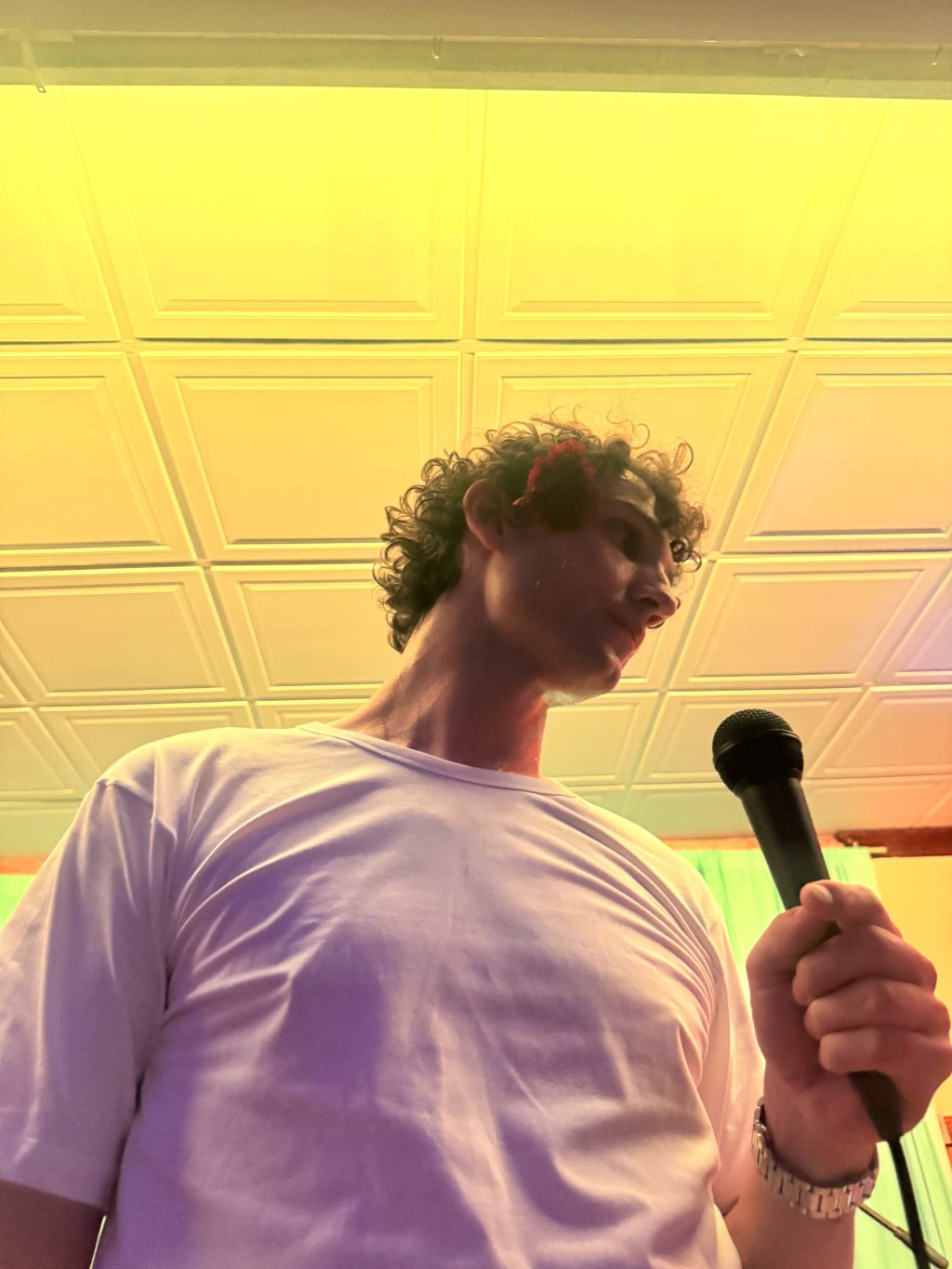
Borzone lumbers up to the microphone and greets the audience, and the group launches into “Ghost of Love,” the first track from Magazine. Borzone’s stage presence is as massive as his heaving voice. His curled haircut, muscular build, and chiseled face make him look like a Roman statue trying to break out of the marble. His voice carries the same weight: as Pickard hammers away behind him, his grunts and gasps sound like Atlas holding up the sonic weight of this band. The robotic phrases coming out of Saguiv Rosenstock’s guitar amp and Jack Tobias’s synthesizers sound hellish, like a techno song being broken and reassembled into a slow, trudging stomp.
The rapidfire Rototom fills of 45 Pounds take a backseat during the band’s playthrough of Magazine. Pickard’s drumming is slower and more spacious, with beats that sound like Massive Attack samples and hints of Hella. Rosenstock is locked to his pedalboard, with swells of dissonant reverb being coaxed out of his amp. His guitar is a one-man orchestra emulating steel pans, church organs, and dissonant string quartets.
Tobias, dressed in an ironed button-up, looks like a possessed library tech using a cursed copy machine as he leans over his table of synthesizers and wires. Rosenstock and Tobias’s cavernous melodies complement the extroverted personalities of Borzone and Pickard’s presences: the band follows the noise rock tradition of blending the robotic and technical with the primal and broken. The songs on Magazine blend like an ominous, monochrome movement that could accompany a scene from The Matrix franchise.
Dionysian is the best way to describe Borzone’s stage presence. He tosses the seemingly endless supply of flowers at the lip of the stage into the audience, voguing with a devilish smile. He holds the microphone with a flower between two of his knuckles, eyes and veins popping out of his face like a royal who’ll behead anyone who’s thinking about the Knicks game right now. The stage heats up like the mouth of a furnace, blaring yellow as Borzone’s sweat and spit lands on the foreheads of the front row. The band charges into the fan-favorites from 45 Pounds, and the crowd splits in half to allow for a moshpit. Pickard’s virtuosity is on full display as he bounds through Rototom fills, and Borzone twists in rhythm with Rosenstock’s guitar noise.
The band plays almost the entirety of 45 Pounds, only breaking for Borzone to mutter “Knicks in five.” Some people in the crowd laugh at this. “Fullback” and “Tearpusher” are especially violent, and the front row gets pushed up onto the stage as a wave of bodies shove towards the front. My friend Maya (who took the attached photo) crowdsurfed as the music got more aggressive. The band’s bursts of high-intensity noise don’t burn them out, but the entirety of the performance is a band displaying the labor of their sound. Their live show is all sputter, struggle, and sweat, and it sounds incredible. The thrashing “Iron Feet” and “Blackout” close the set on a high-octane note. There’s no encore despite the pleading of the crowd. When the band shuffles offstage, the game is still going and the Spurs have a 29 point lead. The tension in The Garden seems small compared to the last 35 minutes. The projection on the wall serves to remind the crowd that YHWH Nailgun can put on a brutal show in the duration of one quarter (plus car commercials).
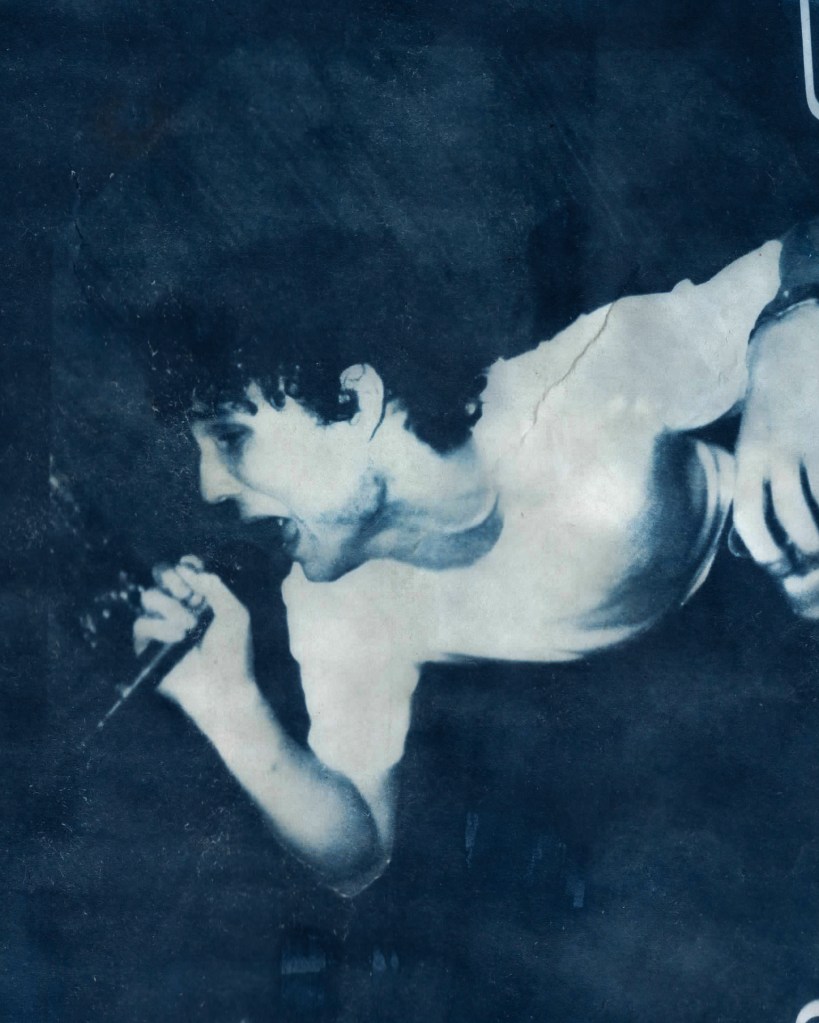
Impressively, the people gathered outside the venue seem more preoccupied with conversations about Magazine than the devastating Spurs lead. Dimitri Giannopoulos of Horse Jumper of Love stands near the blue-awning entrance, and tells me that YHWH are one of his favorite New York bands at the moment. I talk to people who have come from as far as Virginia and DC for this show, checking their phones to see how many minutes til Magazine drops. 23 minutes before midnight, it’s announced that the Knicks have won.
The screaming and cheering from the streets below is audible as some friends and I listen to the first half of the album. Magazine feels dense for a record even shorter than most EPs. “Ghost of Love” sounds far messier and cluttered than it did live—the band describe their short songs as rooms in houses, and the opener feels like too much furniture in one room.
Other than that, the new songs have a beautifully brutalist atmosphere—the swelling drone of Rosenstock’s guitar on “Stillness Blues” and “Hips on a Wheel” is haunting, and the creaks and chirps of Tobias’s synths are far more audible. The band is far less thunderous and aggressive than they are on 45 Pounds. Pickard’s drumming is far less mosh-inducing, with the Rototom aggression swapped for downtempo rhythms and softer fills. Every part of Magazine’s instrumentation seems to be ambiance-oriented, prioritizing texture over structure on most songs. When it flows, like on “Sewer Tree” and “Burns,” the product is rewarding, but some textures feel misplaced. The title track awkwardly cuts off right as the band hits a groove, and Borzone’s lyrics are sometimes too articulate, taking away from the mystique of what he’s saying.
That being said, the new vocal textures on Magazine are interesting: Borzone leans into a Nick Cave vocal croon on “Innocent Sigh.” Engineered by Rosenstock himself, the production of Magazine is far more overdub oriented, and it’ll be exciting to see if the band mixes the gothic textures of Magazine into a batch of songs with stronger structures. When performed live, the arrangements of the songs are staggeringly tight and vital. While YHWH Nailgun shows more conviction and focus on 45 Pounds, Magazine is a metamorphosis worth listening to, and it’s shorter than a quarter of a basketball game.


Leave a Reply