OEN
SummerStage’s park concerts are typically guaranteed large audiences by virtue of being free, but the crowds are usually older concertgoers who opt for the shaded seating at the back of the compounds. The audience for Black Country, New Road, Sharp Pins and Horsegirl in Central Park instead chose to barricade-sit in the sun an hour before the music even started. The crowd looked less like the usual 20th reunion for a college class and more like a current college quad. Many of them already had merch for one of the three bands, and were probably willing to endure a sunburn for the best view. BC,NR are a fairly young and extremely hyped band by SummerStage standards. Sharp Pins and Horsegirl, two jangly guitar bands from Chicago, are even younger. Right before Sharp Pins got onstage, it was announced that the compound was completely full.
Sharp Pins is essentially a Kai Slater (founder of Chicago’s Hallogallo zine and member of Lifeguard) solo project. In the sticky heat, Slater was sealed in a buttoned-up brown corduroy jacket and tight white pinstripe pants, with a retro 70s Gibson guitar slung around his skintight frame. He looks like Keith Richards in regalia, sans torturous heroin addiction. Bassist Joe Glass and drummer Peter Cimbalo’s outfits and instruments were also toned to the mod aesthetic. Those haircuts, those buttonups, in this weather. Why? After seeing The Lemon Twigs, I’ve been skeptical of how original a band that looks like a 1960s cosplay can be, but Slater’s friendly hi hellos made me willing to indulge.
Slater’s outspokenness about his love of 60s power pop and psychedelia made itself piercingly clear when the band started playing. Cimbalo’s beats copy every 1965 Ringo Starr drum groove, bouncing between “I Wanna Hold Your Hand” and “Ticket to Ride.” The first usage of this was charming, the 7th less so. At the beginning of every song, I tried to place where the chord progression and drumbeat came from. Hard Day’s Night, no, no, what’s the other one?
It isn’t Sharp Pins’ fault that they love the 60s aesthetic: Slater’s bouncy stage presence and artificial British accent were cute, plus Glass and Cimbalo’s vocal harmonies were excellent. No matter how much a song resembles The Who’s “Substitute,” the bassline is still irresistibly danceable, the Keith Moon drum fills still fun, so does it matter? As one artsy guitarist’s side project, Sharp Pins are a fun band that serves as a love letter to 60s pop. I just wish that 60s imitators would try and make copies of “Strawberry Fields Forever” instead of just the pre-Rubber Soul stuff.
Slater’s auxiliary guitarist (nameless online) was frustratingly inaudible the entire time, and the treble of Slater’s 12-string guitar started to give me a headache halfway through the set. No matter how much you like The Byrds, I cannot accept song after song of earsplitting treble if it’s just walls of blindingly bright chords. The band’s closer “I Can’t Stop” was the only song I can fully remember, solely because of the breaks where Slater’s guitar dropped out for a crowd singalong. Their stage persona was friendlier than The Lemon Twigs, but Sharp Pins are just as derivative of their influences, and pick only half as many songs to copy.
Horsegirl come from the same scene as Sharp Pins, but their songs were far more distinguishable from one another. The hushed vocals of the Velvet Underground’s folk and the ticking mechanical drums of Stereolab were familiar textures, but Horsegirl’s minimalist songwriting is hard to place. Vocalists Penelope Lowenstein and Nora Cheng, who exchange bass and guitar duties, trade spare Wilco-esque melodies on their respective instruments. Their warm harmonies are simply another texture that they toss in to serve the song and then quietly withdraw. Their energy couldn’t have been further from the knee-kicking pomp of Sharp Pins, yet the music still had energy.
The main driver of each song was Gigi Reece’s rounded, tight drumming. Behind the dry guitars and soft vocals, Horsegirl’s set was a collection of dance songs. When Lowenstein said that the crowd could dance during “Anti-glory” (a song that gives this instruction in the deadpan chorus), the crowd dared to nod their heads and move a little. Horsegirl are at their best when they lean into the groove of Reece’s drumming and let the jagged superclean textures of their songs ring out. Some of their hooks weren’t the most catchy, but the dichotomy of their introverted vocals and pulsing danceability was chemical and memorable.
The band also has humor: they duct tape keys on their mini-synthesizer down as their tuning-and-switching-instruments elevator music, and Reece sometimes plays a beat around it. Their la-di-da lyrics have an awkwardness that feels indistinguishably vulnerable or tongue-in-cheek. “You have a beautiful face/You have a beautiful face/I have a serious face” went one unreleased song. Horsegirl’s mutedness compared to Sharp Pins worked for them in every sense for this concert, and they weren’t wearing three-layer outfits in the summer heat either.
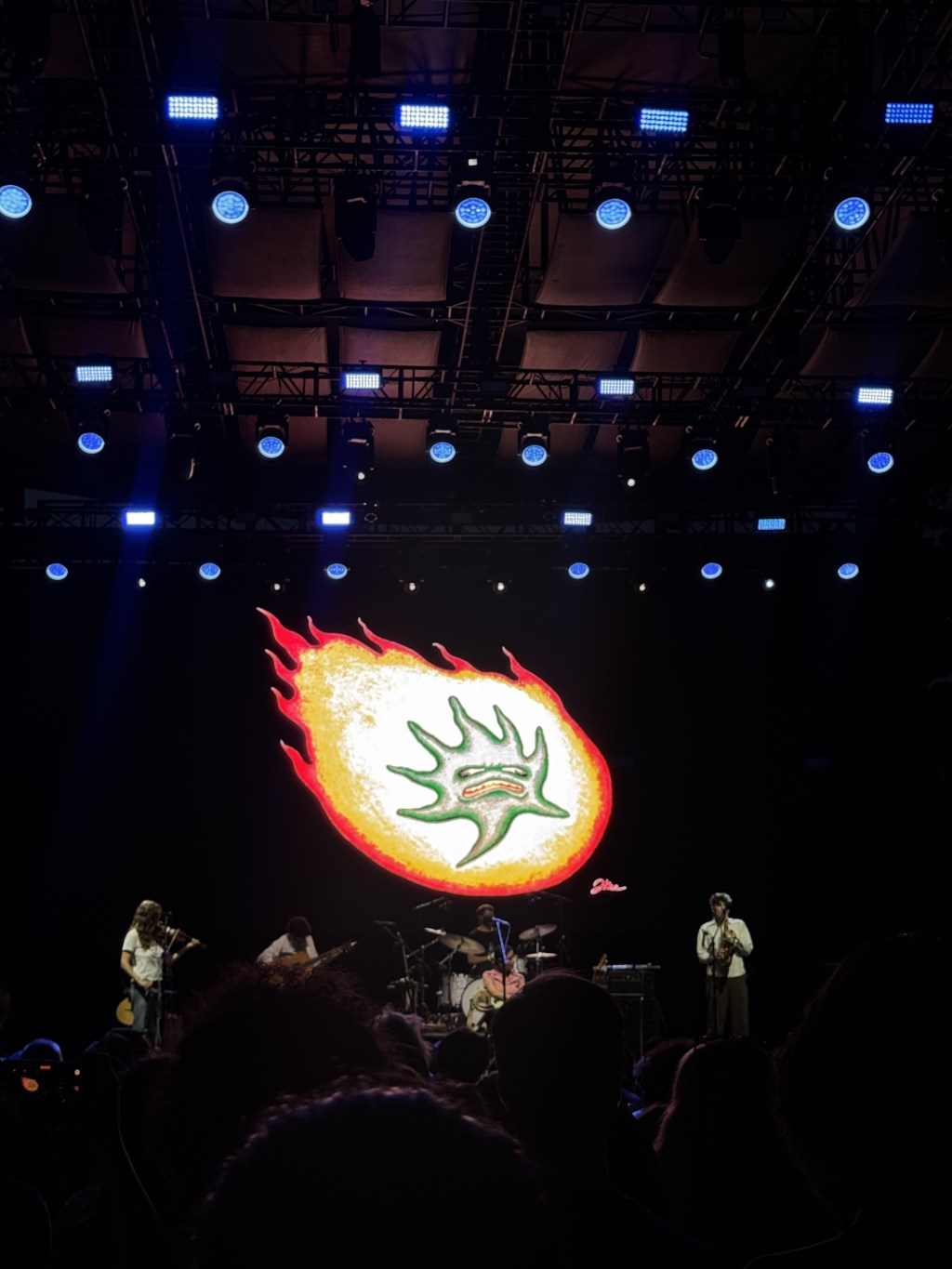
The heat hadn’t subsided when Black Country, New Road came out on stage. The graphic of a crayola-green shooting star inside a fireball was projected behind the band. It’s in the style of the Forever Howlong (2025) cover, which I reviewed here. There were people jokingly debating whether Isaac Wood would come out, since he announced he’d be opening for Phoebe Bridgers on tour next year. His departure from BC,NR has led to a divide in fans still hung up on the guitar-driven post-punk of For the First Time and newcomers who’ve discovered BC,NR through the whimsical, theatrical pop on their new record. There were dozens of instruments set up for the six of them, and they came out in colorful casual streetwear and quickly planted themselves in position onstage the way a chamber music group does.
That’s essentially what they are—from the first song, “Strangers,” BC,NR’s show is a work of musical theater without the obligations of plot, dialogue, and character egos. Still, the show felt like a journey with an arc, and each vocalist was a character. The harmonies of May Kershaw (keys, accordion), Georgia Ellery (acoustic guitar, mandolin, violin), and Tyler Hyde (bass, classical guitar) evoked an ensemble chorus singing a musical overture, and their individual songs were soliloquies of anxiety, romance, grief, and moving on.
In the place of Isaac Wood, the band’s sole live singer in their early years, the band’s live show revolves around one voice carefully balanced between three different textures. The band is more reminiscent of 70s English prog than anything. “Strangers” is the type of song you expect a solo artist to perform with a heavily layered backing track. BC,NR’s live show is the orchestra pit with the curtain pulled back, and the vocals decidedly not upstaging the instrumentation. In the tradition of 70s progressive rock artists, the band has twinkly mandolin-guitar harmonies plucked from a ren fair, lyrics that dorkily and proudly read like Oscar Wilde, and the epic longform song structures that build instrument-by-instrument up to a grand finish.
Like Horsegirl, who BC,NR brought on tour with them, the band exercised spareness whenever they could, dropping out to highlight one voice and one instrument before the song lifted off the ground. May Kershaw’s piano arrangements fit like Tetris bricks in every song, weaving between everything else and pulling it tight. Her interplay with Lewis Evans’ carousel saxophone melody on “The Big Spin” sounded like a modern Sgt. Pepper’s arrangement, and was further evidence that stealing from a band is more impressive when you steal the complex songs instead of the 3-chord ones.
Kershaw, Hyde, and Ellery rotated vocal duties evenly: “Salem Sisters,” “Mary,” and “Nancy Tries to Take the Night” were conducted by whoever was singing them: Kershaw’s songs driven by her piano, Hyde’s by her nylon string guitar or bowed electric bass, Ellery’s by her mandolin. At some points, Kershaw would actually conduct the group’s vocal harmonies with her hands during a capella sections of songs. As kitschy as this looked, the audience was heartwarmed by the band’s family dynamic. Even with Kershaw conducting, the post-Wood lineup of the band looked far more collaborative onstage despite the orchestrations of their songs.
The set did seriously drag at some points. All of the sections between dense instrumentals featured only piano or guitar with vocals, and while songs were never repetitive, it felt like the instrumentals that showcased the band’s songwriting creativity were too brief. To their credit, BC,NR’s songs are poetic mouthfuls that warrant some quiet, but the most astonishing parts of their set were when the full band moved as a unit instead of one of the vocalists being spotlighted for four minutes. The band is probably wary of seeming pretentious—their new material entirely ditches the heavy-hitting drums and violent guitar work of the Isaac Wood era. Only a few times did band fire on all cylinders; when “For the Cold Country” and “Dancers” reached their crux and Charlie Wayne got to pull out massive drum fills, it felt like seeing prime King Crimson or Yes. Instead of flexing their baroque instrumentals with prodigious solos like many prog musicians before them, BC,NR’s virtuosity was dangled in front of the crowd for fifteen seconds before falling quiet again. They needn’t be so modest, the crowd was clearly enthused whenever Wayne pummeled the drums.
The set’s highlight was undoubtedly their cover of Big Star’s “The Ballad of El Goodo,” a twangy 70s pop cover I would have expected Sharp Pins to perform. BC,NR’s arrangement was mostly faithful to the original, and the changes they made felt like expansions rather than deviations. Hyde’s low lullaby voice and Ellery’s high harmonies foiled each other well, and the arrangement of Mark’s twinkling electric guitar melody and Ellery’s acoustic was grand and anthemic when paired with Kershaw’s piano. The performance was symphonic, and stirred up a strange emotional nostalgia during the choruses of “there ain’t no one coming to turn me ‘round.” Whether people knew the song or not (myself included, sorry), some people were practically yelling Alex Chilton’s lyrics by the last chorus. The cover evoked the sense of triumph that the band are reaching for in their new songs, and if this is the blueprint, I’m excited. I’d even be okay with them writing catchy choruses.
The performance of Forever Howlong’s title track was also fascinating: Kershaw sang solo while conducting the rest of the band, who were playing large recorders. It was fantastical, and perfect for a live setting—the whole crowd completely silent, as if also conducted by Kershaw. Following the song, someone shouted out “Play Concorde!” (a song from the Isaac Wood era) when security was helping someone in the crowd. The rest of the crowd resoundingly booed this person, and Ellery clapped back “now’s not the time.” The band get heckled with requests to play their old material all the time, but their performance of “Don’t Tell Me Goodbye” felt like a strangely apt response to the annoying comment. The intimate quiet of the song’s beginning to the massive hits and cinematic modulation at the end of the song sent a firm message that the band can flex as much instrumental muscle and stir up as much emotion without Wood.
The crowd clearly preferred when BC,NR played like a band rather than an orchestra backing a Billy Joel singer-songwriter character. Their song “Happy Birthday” closed the set on a lukewarm note, but the crowd enjoyed it. The rounds of ba-ba-ba vocals and musical theater drums were a bit campy, and I left wanting more of either BC,NR’s poppiness or their virtuosity. They’re somewhere in the middle right now, and whenever they lead to one side the results are sublime. Black Country, New Road are a band of odds and ends—instrumentally, vocally, lyrically, and evidently in terms of their fan base after a jammed SummerStage show. If they let the extremes of their pop side and progressive side shine instead of muting them both, I think their fans would be appreciative.
 For General Admission: Music Journalism and Other Writing by Owen Neaman
Leave a comment