OEN
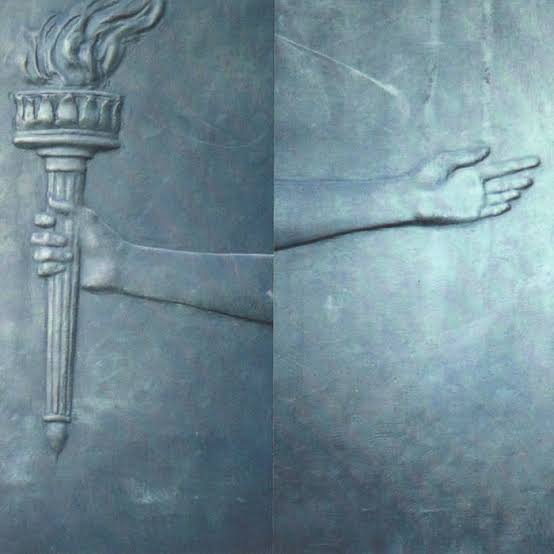
One month after the Twin Towers fell and less than ten days after the United States invaded Afghanistan, D.C. punk band Fugazi released The Argument. They’d been playing the songs live for months, but as soon as the album was released it was impossible not to see it as a post-9/11 meditation on America. Unbeknownst to everyone (the band included), it would also be their final record.
After 15 years of relentless touring in a van, playing all-ages shows with tickets less than $10, and recording a streak of politically incisive albums on Dischord Records, Fugazi announced an indefinite hiatus in 2003. The Argument was the last time Ian MacKaye, Guy Picciotto, Brendan Canty, and Joe Lally appeared together on a project. The four members have expressed the same sentiment when asked about reuniting: their choice to take a break was unanimous, there was no animosity or pressure. They had simply written all they had wanted to write, they didn’t feel the need to continue devoting their lives to a project that felt finished and demanded so much energy. But now more than ever, The Argument sounds like an intentional send-off, the final report from a band who weren’t just forecasting the fallout of 2001 but of the effects of imperialism and late-stage capitalism in the 21st century.
It’s now 2026, and we have been watching a genocide unfold in Palestine on our phones for three years, artificial intelligence corporations soiling the environment for profit with little government resistance, and immigrants being kidnapped and put in concentration camps. The escalation of some of these problems traces back to the events of 2001, but listening to The Argument is a stark reminder that the root of these problems isn’t one administration or one war, but a cycle of violence and desensitization. The album is often pointed to as the band’s most explicit political dissertation, and its time of release is undoubtedly why. But all of Fugazi’s albums could be seen as “predictive.” The Argument, though, is an examination of oppressive patterns and systems that have always been there.
The album’s arrangement is far more studio-oriented than the raw and dry live sound of their early records. The band, which started as just bass (Lally), drums (Canty), and two guitarist/vocalists (MacKaye, and shortly after the band’s first show, Picciotto), had slowly expanded their studio instrumentation over the course of their career. Picciotto would occasionally play droning clarinet on the band’s dub-influenced songs, and they’d occasionally double bass parts with piano. Their live setup remained basic in order to ensure that they could kick into any song at a moment’s notice without stopping; they famously improvised their setlists based on how they felt and how the crowd was reacting. The band analogized that “the albums were the menu, the show was the meal.”
In order to capture their live sound in the studio, the group limited the amount of overdubs and outside musicians on each recording. But for the first time ever, Fugazi had called in an entire roster of external musicians to record: their roadie Jerry Busher playing a second drum kit and percussion, Busher’s friend Amy Domingues on cello, and female backup singers (none other than Kathi Wilcox of Bikini Kill and Bridget Cross of Unrest). Fugazi, a band known for stretching and experimenting what they could do with just bass, drums, and electric guitars with little to no effects, had practically enlisted an orchestra for this record. While Busher had been playing second drums live since 1999, this was the first album where the band would arrange multiple drum parts on the same song. Robert Christgau’s label of “punk chamber music” isn’t far off: the band may have still held to the menu/meal philosophy for this album, but The Argument sounds more symphonic, constructed, and studio-oriented than the band’s other work.
The untitled opening track doesn’t even feature any of the band members. It’s one minute of what sounds like radio chatter and static, interrupted by serrated stabs of Domingues’ cello. The chatter is unintelligible, becoming a droning musical frequency that creates an eerie harmony with the icy string part. The crackling tape fades, it won’t be the last time we hear it on the album.
The sound of a hand sliding on an electric guitar neck opens “Cashout”. Fans have likened the sound to a gun being loaded, either by the oppressive forces detailed in the song, or the band gearing up to make their opening statement of The Argument. The gatling drumbeat sounds like it’s keeping a militia in time. A snarling guitar plays a riff fit for a string quartet once, then drops out. Lally enters with an ominously melodic bassline that locks into a march with the drums. Picciotto plays a soft, cobweb-thin countermelody on his guitar as MacKaye steps up to the microphone—not shouting in the classic Ian MacKaye dog-bark way, but softly and clearly singing. “On the morning of the first eviction/Carried out the wishes of the landlord and his son/Furniture’s out on the sidewalk next to the family/That little piggy went to market, so they’re kicking out everyone.”
MacKaye sings about gentrification like he’s singing a nursery rhyme, one as sweet and so clearly fucked up as “Rockabye Baby”. This is the same guy who sounded like his head was about to explode when he sang about gun violence or abortion bans, singing like he’s chiding a toddler as he coos about “forced removal of the pee-ople on the corner.” The effect is uncomfortably reasonable, as if MacKaye is negotiating terms of surrender with the listener. This is the way things are, the storm is already here, the song seems to say as the listener bobs their head to Busher’s grooving percussion as MacKaye sings “Development wants, development gets/It’s official.” MacKaye whispers a gentle slogan; “Everybody wants somewhere.” The three words turn from factual sentiment about human nature: everybody wants a roof over their heads, everyone wants somewhere to be. This sentiment changes when the guitars and drums burst into a blistering breakdown of squealing feedback and Domingues furiously bowing a cello line that could fit a gothic horror movie. MacKaye repeats “everybody wants somewhere”, now in his signature punk dog-bark, turning it into a chant: “Everybody wants, SOMEWHERE! SOMEWHERE!” MacKaye’s voice of reason is gone, in its place is a primal sense of anger, a balance the album develops with every song that follows it. It’s the calm normalcy of late-stage capitalism coming face to face with the trauma of the underclass.
“Full Disclosure”, the first song that Guy Picciotto sings, is representative of this full-on panic. The tremoring guitar part that opens the song rings with anxiety, and Picciotto’s voice-cracking, oddly sensual shriek of “I want out, I want out, I want out” repeated ad nauseam are smothering. The oohs from Kathi Wilcox and Bridget Cross are a spoonful of sugar that accompany a sour Picciotto as he sings about wanting “a life seizing separate culture to take me over…coming sponsored by no one.” The paranoia around the dot com boom seems like an ant hill compared to the stresses about Artificial Intelligence taking people’s jobs and tech companies wreaking havoc on the environment in the name of economic progress, but Picciotto’s panic takes visceral aim at the internet’s seemingly invisible invasion of every aspect of life. The climax of the song is a mix of electric guitars and modified guitars playing an ear-piercing, undulating note that slowly burns out, fading into a dark chasm of echo before going quiet.
The searing, single-riff anthems that Fugazi were known for took a backseat on the album: in fact, the same day The Argument came out, they released an EP of three songs that didn’t make the cut. “Furniture”, a start-stop “Waiting Room”-esque song that they had played early in their career, retired, and then brought back from the dead, the blistering instrumental “Number 5”, and an explosive, breakneck punk song called “Hello Morning.” All of the songs are fantastic, but are far more boisterous than most of The Argument. Everything about this album is cold and steely, and even the harder rocking songs have more solemnity than most of the band’s material. The Argument’s tracklist is composed entirely of songs that try and thrash off the grips of desensitization and hopelessness, and songs that depict being fully trapped in that cycle with no way out.
“Epic Problem” is a thrasher, taking the start-stop song structure that the band were known for and use it as a lyrical device to portray a soldier sending a telegram (at the end of each line, MacKaye sings “stop” as one would when dictating a message on a telegram machine). After two choruses, the start-stop cycle breaks, and Jerry Busher joins Canty on a second drumkit: they play the same throttling beat, and the result sounds massive. The gnashing guitar harmonies and propulsivity of the rhythm section accompany MacKaye as he tries to shake himself from fatigued dehumanization: “Inside, I know I’m broken, but I’m working as far as you can see,” he sings.
The next songs are far more grim: “Life and Limb”’s insidious call “Hey, we want our violence doubled,” with Cross responding “No, but really in a loving way.” The weaving guitars sound like Smiths pop songs, and the bass and drums sound vital, but rigidly obedient, like the marching groove on “Cashout”. Picciotto’s voice is completely dry as he sings about America’s insatiable desire for inflicting indiscriminate violence on countries that we perceive as threats. It’s a song about sick foreign policy that cuts deep when your country is bombing schoolchildren in Iran in the name of counterterrorism. “Life and Limb” was debuted live four whole months before the US/Afghanistan war, and if any song is indication that the violent shots our country takes are stupidly predictable, it’s this one. It’s also worth noting that in the middle of this song is a sedate, eerie guitar break—perhaps the only proper “guitar solo” in Fugazi’s catalogue, placed in the middle of a pop song justifying war crimes.
“The Kill”, sung by Joe Lally in a droning croon, takes a look at the home front. An eerie soundscape of squealing delay, cavernous echo effects, and trippy percussion flanks Lally singing to newly drafted soldiers of all backgrounds. The lyrics could be addressing a horde of brainwashed zombies: “Academic or street education/Obtain degree in annihilation.” The end of the song is the crux of political subservience on the album: “Laid out immobile/Hoping for that call/It’s in my mouth, under my skin/Sodium Pentathal.” A chilling breathing sound comes into the mix, presumably the lethal injection chemical of Sodium Pentathal being administered, either killing a defector or torturing a subject into submission.
The second side of the record is far more meditative than the action-packed first half: “Strangelight” is a tapestry of piano and disjunct guitar parts accompanying Picciotto as he laments how “nothing grows right anymore.” The song crescendoes into a dissonant symphony of piano, electric guitars, and cello playing the same haunting riff before crackling out. The lines about scars on every stalk and nothing growing right are the album’s lowest emotional point, the stage right before getting up and trying to effect change. In late-stage capitalism, buying from corrupt companies and forfeiting privacy to websites makes it feel impossible to live: we become accustomed to being watched, being tracked, and consequently being cornered and manipulated by the companies that spy on us.
“Oh” is a direct response to this mentality, as Picciotto talks about “waiting for the bottom to drop” in the midst of the dot com bubble. The song’s prescience equally applies to AI companies bent on expanding to the point of monopolistic control over every job. In the name of technological and economic dominance, the “thread-held anvils” described in the song are set up, with no regards to the devastating impacts on workers, the environment, and the well-being of the world. Hearing such a despairing song about an antiquated issue brings to light that it isn’t OpenAI or Anthropic that are the root of these problems, but universal the lack of interest in keeping tech companies in check. The sentiment in “Oh” isn’t a 2026 phenomenon, nor is it a 2001 phenomenon: they’re symptoms of America’s longtime prioritization of industrialization over people.
“Oh” begins a run of songs that I hear as Fugazi’s Abbey Road medley: the band stitch together passage after passage of melodies and rhythms that could be the basis for entire songs. Its psychedelic guitar breaks and harmonized tremolo-picked guitars sound orchestral, “Ex-Spectator”’s double-drumkit intro and synchronized guitars sound ominous and stalking, and “Nightshop”’s middle-eight freakout of acoustic guitars and sped-up synth sequencers sound worlds away from the bone-dry punk songs of the group’s early EPs. The band’s longtime formula of instrumental foiling is perfected here: the squealing high melodies of Picciotto’s guitar cut through MacKaye’s gritty, rasping rhythm parts, Busher and Canty’s embellished drum parts weave around each other before syncing and driving forward, and Lally’s eerie bass melody counterpoints the faint piano after the first chorus.
Fugazi is an institution so old it’s admitting its own exhaustion and burnout on this album: “Nightshop” especially paints a picture of fatigue and emotional pressure as a band on the road with no crew or external support. At the end of the song, the radio static from the intro track returns: except it isn’t radio static, it’s the sound of the band’s van breaking down (confirmed in an interview with the band members on the podcast The Alphabetical Fugazi).
The title track “Argument” opens with a frail, singular note, then two, then a repetition of the whole phrase. As Canty’s drums kick in, it’s clear that this isn’t one of Fugazi’s end-of-album freakout jams (see “Shut the Door”, “Glue Man”, “F/D”). Instead, the band locks in on a silky chord progression, played straight and softly. The lines “When they start falling/Executions will commence/Sides will not matter now/Matter makes no sense” is a final thesis for the album: that this country will fight wars for the sake of war, and anything caught in the crossfire won’t be granted safety, mercy, or humanization. I heard this song for the first time when ceasefire negotiations in Gaza began. Since then, Hamas has been destabilized and its leaders have been killed, but the genocide continues on our dollar. “The Argument” that MacKaye sings about is a ubiquitous synthesis of every “reason” and “rational defense” America uses to justify our killing and destruction. The line “Some punk could argue/Some moral ABCs” has been frequently quoted as the album’s single defining line: is MacKaye fed up with explaining the politics of the world through song? It might be the most pessimistic line in a discography full of pessimism, and it’s followed by a call to action of being “on a mission to never agree.” It’s hard not to hear the lullaby-excuses for gentrification on “Cashout” as simple bystanding: America’s economic choices in the name of war are conscious, and people suffer in the name of American imperialism and militarism, both here and there.
The final minute of the album is probably the finest collaboration between the four band members: an underwater-sounding keyboard melody and washed-out drum beat take over for a few measures, and then the entire band cuts out. It’s just Ian’s guitar playing two low, jagged notes. The rest of the band come in at once, Picciotto playing a mournful, shrill guitar riff that sounds like a troupe of bagpipes in a funeral march as MacKaye sings the refrain “Here comes the argument” louder and louder until he’s screaming. It almost sounds like a Motown song, with Lally and Canty’s driving groove underneath the chaos, mixed in with Jerry Busher’s tambourine. Picciotto’s guitar is all of the strife and pent-up anger of the album synthesized into one melody of release. This is the band firing on all cylinders, their own version of The Beatles’ “The End”, and it sounds like they know it. All of a sudden, they seize, lurching three times to a halt as Canty lays down sputtering drum fills. They drone for a few seconds, and then with a final hit of Canty’s hi-hat, they go silent.
Early in my Fugazi obsession, I kept reflecting on whether this is the band’s last album. Now, I’m glad that it is. Hearing the final minute of The Argument each time I listen feels like processing the instructions of a guidebook. It’s jarring hearing an album from 2001 that’s relevant to the news of 2026, but looking past the ostensible prescience is a feeling of solidarity, and confirmation that the problems now stem from the same thing that created the problems then. MacKaye expresses distaste for their songs being used as political dogma, but the final Fugazi record is more of a reminder to keep your eyes open. Sure, The Argument is absolutely unique because of its time, with the rise of the internet, mass gentrification, and Bush-era militarism influencing most of the songs. Though the more you listen, the more universal the themes sound: at its core, The Argument is simply about being the mission to never agree: standing by as people are dehumanized, turning a blind eye to the side-effects of billionaire conquests, and neglecting the issues of imperialism until they affect you directly. Whether or not Fugazi intended it to be their last record, this album argues that violent political patterns don’t break themselves, and being aware of their root causes is the first step in breaking from them.


Leave a Reply